Monday, February 28, 2011

2nd Day Working in Petit-Goave

Day 4
2nd Day Working in Petit-Goave
Today is day four of our mission here in Haiti and the 2nd day of work at the Petit-Goave site. We did not do any work of consequence today although we spent a lot of time playing with the  kids and watching the Haitian men apply plaster to the outside of the church activity center.  They are expert at applying wet, soft mud (mortar mix) to the side of the building in a rapid and exact fashion at the right thickness.
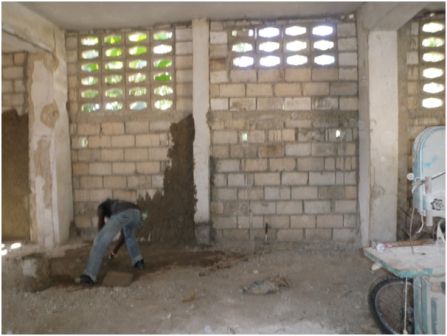
Applying Mortar Coating Inside
We helped the masonry team by mixing mortar and concrete as they apply it to the inside of the activity center today.  Although there wasn’t enough work for the 8 of us to participate we worked as a team and took turns shoveling and sifting.  The highlight though of today was a surprise visit by four youths and other several other smaller Haitian kids who came by to see what we were doing and to see what the “blanc” (white) people were doing.  We played soccer and Frisbee in the afternoon and learned more about them as they learned more about us. 

Haitian Kids at the Work Site
As one might expect, they are all good soccer players. One young man of about 15 years, had exceptional command of English and was also well versed in the Methodist religion.  Nancy thought he could easily be trained in ministry or as a teacher.  All the people here and especially the youth and children are very friendly and affectionate.  Many of the younger children held our hands as we walked around the site and stroked our heads.  It’s something that I think is pretty common when they don’t see many people like us here.
We have all agreed we are a team of individuals that have come together to do a job in Haiti, but we are having a hard time understanding what that job looks like and how it is to be accomplished.  At about 3PM we came home and had a long discussion amongst the group regarding  how we can be more productive with our time here since it is limited; tomorrow is Sunday we only have 2 work days left.  We all wish that there wasn’t such a lack of meaningful  work . We did not make any world changing conclusions but believe we must pursue most of our questions and concerns in some official manner with the UMVIM/UMCOR non-governmental organization (NGO) that arranged most of our accommodations and partially funded our project here.  Steve and I calculated that UMVIM with the UMCOR matching fund is bringing about $1.5 million dollars a year into the Haitian economy assuming that there are at least 3 teams a week down here for most of the year.  Of the $43 million that UMCOR has been given for Haiti relief efforts, about 10% of that is being used to match UMVIM volunteer dollars for each project.  There is about $3 million more remaining in the fund which was just released for projects in October of last year.
Later that evening we had an informative discussion with Pastor Admirable about the Methodist church her e in Haiti.  He said Haiti has 13 Methodist districts which each have a district superintendent.  Pastor Maude is the Petit-Goave district superintendent.  She and Pasto Admirable have 24 churches each that they have to attend to in this district; it takes them 6 months to see each of them (one every Sunday).  There are approximately 45 lay preachers in the Petit-Goave district.  There are about 7,000 to 8,000 Methodists in Haiti and about 184 schools are sponsored by the Methodists here.
Pastor Admirable’s House

Front Yard of Pastor Admirable’s House
The weather has been warm, close to 80 degrees, but it is not too humid so we can handle the heat during the day.  Although it’s been fairly hot at night, each of our rooms has a fan.  Unfortunately, Pastor Admirable’s house is located directly adjacent to a disco which plays very loud dance, rap, reggae and Haitian music late into the night.  Most of us have been averaging 4 or 5 hours of sleep a night.  They love music here as every night a truck or van drives down the road in front of our house advertising loudly that there are more dance places in Petit-Goave.
Tomorrow we are going to attend church service with Pastor Maude outside of Fond-Doux in the mountains at the Eglis-Methodiste De Nabosse church and are going to get an early start with wake-up at 6AM, breakfast at 6:30AM and to commence our journey after 7AM.  That’s all for now.
-          Bruce Stirling and Bob Dixon                            

Saturday, February 26, 2011

Day 3 - Working in Petit-Goave


Day 3 – February 25, 2011
Working in Petit-Goave
Today is Friday and after a good breakfast we walked back to the work site and were quickly assigned to several tasks that involved moving building stones, bricks and other earthquake debris out of the building.  Our project is at Pastor Maude’s complex
The Arkansas UMVIM team helped by sifting limestone rock through wire mesh which was used for mixing mortar that went on the building and helping to cut metal pieces with a chop saw for reconstructing windows. 

Sifting Limestone for Making Mortar


Some of the UMVIM Team from Arkansas; Bubba and Mike


Haitian metal workers also spot welded metal into decorate covers for the windows.  The major metal work project was a beautiful door that I understood was going on the new church being built in Fond-Doux.  I had no idea that metal fabrication down here was such an important skill. 

Fabricating Metal for Windows and Doors
 
Seeing this project and how the people here get by with so little, I can’t help but admire them and how resourceful they are with having so little to work with.  They try and make the most of what they have and much of the useable materials get recycled.  It makes me think why I need all the things I do when they complete essentially the same tasks with a fraction of the supplies and resources.  Like Steve commented, “when you don’t have a Home Depot or Lowes down the street, projects become a major challenge.” 
Our primary task was to clean up the inside of the church activity building while the Haitians worked on the mortar and plaster.  I think the goal is to rebuild the exterior and interior walls and replace the windows and doors and then paint everything. This was physical labor and the conditions were hot and dusty but everyone in our group was right there lending a hand and helping each other as best they could.  Everyone was smiling and happy despite how hot and dusty the conditions were.  While we worked, 2 UMCOR administrators visited our site to check on our progress at Pastor Maud’s as well as other sites in the Petit-Goave region.  Nancy, Steve, Mary Margaret and Ricardo discussed with them some of our concerns regarding funding, organization and project understanding.  Only a few children came to the work site today.  I think there will be more as they find out that we are here.  No matter where we go, it seems like we attract a lot of attention.  Almost like you are a movie star back home.
Here are a few pictures of our first day working at Petit-Goave.
Cleaning Rubble from Inside


Plastering the Walls with Mortar

Ricardo Speaks with UMCOR Representatives

 - Bruce Stirling

Day 2 - Petionville to Petit-Goave

Day 2 – February 24, 2011
Petionville to Petit-Goave
Today we travelled from the Petionville guest house to our job site in Petit-Goave where we will be for the next 6 days.  The Petit-Goave site is in a more remote area and we are told less reliable for internet service so our posts and emails made be delayed be a few days.  I'll try and upload these photos as we have more time.
This day started with  a great breakfast at 7AM with a number of UMVIM groups from Washington D.C., Texas and New Hampshire.  We then packed and then left for Petit-Goave. There were the 8 of us from Vashon and Gail, our driver Axel plus our 27 year old interpreter, Ricardo.  Gail was meeting another UMVIM group in Petit-Goave.  All UMVIM groups in Haiti are assigned an interpreter who is hired by UMVIM to assist in language barriers at the work site and throughout out stay here.


Leaving Petionville Guest House


Our 11 Passenger Van
Our luggage was transported in one van while we left in an 11 passenger Kia.  Seeing the streets of Petionville again and on through to Port au Prince and into the countryside to the southwest of Port au Prince was more interesting today than it was yesterday.  The colorful Tap Taps (Haitian Taxis) were packed with people and we saw them on almost every street.


Colorful Tap Taps


Typical Street Vendors
The earthquake damage was more evident now as we traveled through some of the steeper parts of Petionville and back down into Port au Prince.  We also noticed several “tent” camps where crowds of people were living in stressed conditions.  Ricardo told us that many Haitians were still living in tents because of the fear of another earthquake and didn’t want to move back to their homes.  We also saw many homes being repaired along the way.


Evidence of the Earthquake


Repairing the Damage
After a short time we came to an area that had some of the worst living conditions we had seen yet. We all were not sure what to expect once getting here but this may have been more like my vision of what Haiti was going to look like.  It’s difficult for us to understand the way Haitians can live with garbage littering the streets.  Sometimes the smell of burning garbage, food and dirty water were difficult to take along the drive.  Dirt and dust from the roads mixed together with uncontrolled surface water runoff combined for what I would consider unhealthy living conditions.  Although it’s a stark contrast to where we live, the unsanitary conditions (on the surface) don’t seem to affect the people here as they go about their daily lives like we would on a typical Thursday morning in Tacoma, Seattle or Vashon.


Garbage Everywhere
One of the most shocking sights to me was this garbage landfill and an example of how poor some of the people are here.  We saw burning piles of garbage and kids sifting through the trash in the midst of the all the smoke and ash.  I wondered what kind of respiratory stress these conditions must have on them.
Burning Garbage at a Roadside Landfill
As we left the crowded street of the city, the road opened up and the bay appeared on our right.  There we saw vegetation typical to a tropical area; banana trees, sugar cane, mangos. There were quite a few less people as we made our way further into the countryside.  We could also see some of the mountains surrounding the bay above Port au Prince.


Mountains Overlooking Port au Prince
The driving, which was generally crazy and uncontrolled in the City, now became a bit more dangerous as the road opened up and rate of speed become significantly greater.  It reminded me of driving in Mexico where road hazards were common and cars and trucks all raced each other down the highway to be first.  It didn’t seem to matter who or what might be in the way; it was drive faster than the person in front of you.
We encountered some significant road damage and had to slow down at these places and where some speed bumps or Topes were.  There were also several damaged bridges that we saw along the way.  This particular bridge had a by-pass where we drove right through the river.


By-Pass for Damaged Bridge
After about 2 hours we arrived at Petit-Goave and met with Pastor Maude, a soft spoken woman with a strong accent who spoke fairly good English. After some discussion with Nancy about doing some children’s activities, she arranged for us to attend church with her somewhere “up in the mountains” on Sunday where we could be closer to some of the children.  She said that although we could go to the local children’s school, they had over 200 students and that unless we gave gifts to all the children, it made things awkward if a someone didn’t receive something . 


Meeting Pastor Maude in Petit-Goave
Pastor Maud then took us to look at the project we’d be working on and discussed with the local foreman what we’d be doing the next day. The project consisted of repairing a meeting center on the property that was damaged in the earthquake.  Local Haitians were plastering the exterior of the building with stucco that day.


Plaster on the Meeting Center Exterior
We left Pastor Maud’s place and walked down to a house that is owned by Pastor Admirable who is also part of the Methodist church and UMCOR/UMVIM support efforts in the region.  Pastor Admirable lives about a ½ mile down the street from Pastor Maude.  We are staying at his house for lodging and food while we go back and forth to Pastor Maud’s to work.  We took a leisure walk down to the beach with Ricardo and relaxed until dinner time. 


Walking to the Beach


Beach in Petit-Goave


Discussing Our Expectations During Lunch
After that we had some engaging discussion about our thoughts and expectations so far on the trip.  We discussed whether the UMCOR/UMVIN organization needed a local manager to oversee all the projects under their combined efforts.  Someone to identify each project’s specific needs prior to groups coming to Haiti.  For the 8 months leading up to this trip including the first days we spent with Pastor Tom, nobody could tell us what we were going to be helping with.  Without knowing in advance what we were doing it became evident that some or all of the tools we brought may be obsolete.  It seemed to some of us that knowing what each project would be in advance of our trip would have helped in our preparation.  Steve told us again, as he did before our trip, to keep our expectations low and to be flexible.  Our roles would be much clearer as to what types of work we’d be doing very soon.  Some of the things that concerned me were: why 2 teams at one location; what would we do; what was our purpose; do they need us here;  do they have the skills to successfully organize and run more than one work site.  Each of us hopes that our questions will soon be answered tomorrow.
- Bruce Stirling

Wednesday, February 23, 2011

Vashon, Washington to Port au Prince, Haiti

Our group of 8 arrives safely at the Petionville Guest House after nearly 24 hours of travel.  We are introduced to Pastor Tom Vencus and Dena, another UMVIM member from Minnesota who is volunteering here in Petionville for 3 months.  Things appeared a bit tenious at first when Bob Dixon wasn't sure he'd be able to go as a standby on a 99% full flight but our hearts and spirits were lifted as we he walked down the row to his seat as the plane doors were closing.  The only tradegy on the flight was the chain saw which Alaska Airlines wouldn't allow because, although new and still in the box, contained gas vapors.  We hope that another UMVIM group can bring it down here.

Bob W. and Bob D. along with Vonnie, Sandie and Bruce traveled together from Seattle and met up with Nancy and Mary (who left early from Seattle) in the Miami Airport.  The airport seemed to be bustling with foreigners from all over the carribean.  We posed for a group photo in the Miami Airport before bording our flight to Port au Prince. There was a mix of amerians and haitians on the plane.


Group Photo in Miami: standing L to R, Mary, Vonnie, Nancy, Bob D., Sandie, Bruce, Bob W., and Steve 

Upon arrival, the atmosphere surrounding the Port au Prince Airport was busy and festive.  A live creole band greated us as we were transported to customs.  Here's some video of entering customs:

http://www.youtube.com/watch?v=TlQLcIPTmu0

I took a few photos of our entry into the country and customs area and of the craziness at the customs and baggage claim and of Jackson (the one arm baggage director) and his cadre of plaid shirt and red hat assitants. 

Entering Port au Prince Immigration

Bus Ride from Gate to Customs Terminal

All of a sudden it seemed like everyone at the baggage area was wearing plaid shirts and red hats as they argued over who would take our bags.  Steve put it nicely in a prior post, "it was like running the baggage gaunlet!"


Jackson's Cadre and Running the Baggage Gaunlet

Driving in the front seat of a passenger truck in a third world country like Haiti is an experience I think everyone should consider taking on.  The smells, sights and sounds of Port au Prince and what poverty in a third world county is really like came home to me during the hour and a half drive from the airport to Petionville (a distance of not more than 5 or 6 miles).  Here are a couple links to some video I took during the drive.

http://www.youtube.com/watch?v=HaCYhAtf00s
http://www.youtube.com/watch?v=7RyyIJcWbHg
http://www.youtube.com/watch?v=HsU8bHtOQwE
http://www.youtube.com/watch?v=t71TepOCCrQ

There was some evidence of the earthquake in form of rubble from damaged structures but much of that has been cleaned up in the Port au Prince area.  Some of the areas we may see tomorrow may have more evidence of the damage as we go closer to the epicenter and futher away from Port au Prince.  The road up here to the guest house was so overly crowded it didn't seem possible to move.  Men, women and children spilled onto the streets where sidewalks didn't exist and dust, diesel and smoky exhaust from vehicles was everywhere.  The roads suffered severe damage and it was evident.  I didn't see any form of traffic control and there were many near misses with motorcycles and bicycles. Our driver wouldn't stop honking his horn...I wasn't sure if he was saying "hi or get out of my way". 

Vendors and their shelters were almost continuous along the streets up to the guest house with their goods littering every busy intersection.  There is a definate lack of sanitation with everday garbage everywhere mixed in with roadside ditches running with water. 

Despite the perceived chaos it seems like people here exist in this community in a way that we would probably say couldn't be possible.  From the Haitians whom I talked with, everyone seemed to be friendly and able to get along.  It's clear though that many are poor and lack basic needs like a healthy diet.

We'll that's all for today.  Tomorrow we leave for Petiteguave where we'll be for the remainder of the trip.  It may take up to 3 hours to get there. We were told that the guest house there has internet access but the reliability of the system is questionable.  We hope to post more details tomorrow.  I hope those that view these updates post comments or questions.  It's hard to put down in words everything that is happening here.

Bruce Stirling, February 23, 2011

Monday, February 21, 2011


Sunday we were commissioned by the Vashon United Methodist Church for our VIM work in Haiti. That service, the journals we received from the Care Committee and support from family and friends definitely give us the feeling of being surrounded by the love of our communies.

Monday, it feels like a quiet time of preparation and centering on the work ahead. Our suitcases and bins of tools, power saw, childrens activity materials, and soap pockets are all packed. Tuesday, February 22 later in the day we will fly out of Sea Tac airport and arrive the next morning in Port-au-Prince airport. After an orientation and a night's rest we will travel in vans to our work site and Methodist guest house in Petit Goave.

Nancy Vanderpool

Wednesday, February 9, 2011

February 8th Email from Steve

Hi all,

This will be the last report from Haiti this trip.  We fly home tomorrow and I will be coming back with the Vashon Island United Methodist Church team in two weeks.

Today we took a teeth rattling, bone shaking and bladder splitting ride up to the the village of Furcy.  Furcy is just below the top of a mountain that lies two ridges south of us here.  It is about 5,000 feet in elevation.  The village consists of a clinic, a church a school and some small farm huts.  We took a very bumpy road up the 12 miles from here, a few hundred feet above sea level, to the top of the first ridge, and through a saddle that connected to the next ridge.

The road up was steep, bumpy and crowded for the first half  the distance or so.  As we climbed in elevation the soil changed from the chalky white rock that is around Port au Prince to very red volcanic soil.  When we got to the top of the second ridge, we parked the van and walked about 3/8 mile down a steep trail to Furcy.  Furcy is an agricultural area and the mountains are terraced from the tops, over 5,000 feet to the bottom.  The terrain looks a lot like the steep portions of Hawaii with the long, steep, narrow, parallel vertical draws that run top to bottom, except it is almost all cleared and terraced.   At Furcy the mountain top has pine trees, banana trees and bamboo where it has not been cleared and terraced.  There are also black raspberries that look just like ours at home.  The farm plots are fairlyy small and they grow all kinds of produce. When we were there they were harvesting cabbage.  We were told that because of the poor roads and infrastructure about 60% of the produce they grow goes bad by the time they can get it down to marked.  The view from Furcy is beautiful, but you can see some serious erosion in various places.  The crops looked good, but there were lots of areas you could tell had been farmed but were not any more. We were told that the last hurricane pretty much destroyed the entire local farm "industry" but that seed and fertilizer had been brought back in and production is picking up again.

Today was clinic day and there were a number of Haitians waiting for the doctor and nurse.  They come to the clinic one day three weeks a month.  Although Furcy itself is quite small the school and clinic serve a population of thousands.  We were told people will walk 10 miles to the clinic from further out in the mountains. Unlike around Port au Prince, most of the homes were not concrete block, but were either hand split lapped wood siding over bamboo frames or mud and stick waddle.  The homes were about 15 feet plus or minus on a side and most were one or two rooms.  There are some concrete block homes, but they did not seem to be the majority like down in the city.  Some of the buildings have electricity.  They run it up from further down the mountain using barbed wire.  It is strange looking up and seeing barbed wire run through the trees.  Insulators are anything that won't conduct electricity.  One was a plastic dish soap type bottle stuck on a cut off limb.  The wire was run through the loop formed between the handle of the bottle.

We also visited the school.  We packed in school supplies for the kids, along with a few toys.   The kids and principal were very happy to have visitors.  As I told you before all the schools operated in Haiti are fund by churches and other NGO's.  The kids all wear school uniforms that identify which denomination's school they attend.  As you go around in Haiti you see kids in all kinds of different colored school uniforms.  At Furcy there was a real contrast between the bright clean school uniforms the kids wore and the clothes the older people were wearing around the farms.  Even though the schools are sponsored by churches and non-profits families still have to pay some tuition for their kids to go to school.  Only about 55% can attend, even with scholarship programs to help.  Many poor families put a very large percentage of their income for the kids to attend.  One of the outcomes of the quake is that the Haitians are even poorer than they were due to the loss of work and the local churches are not getting the revenue from their own members they were, so their having an even harder time supporting the schools and clinics. 

When we got to Furcy, we only met older women, other than the people we met at the medical clinic and school.  The children were at school and the men were at work.  One very elderly woman was weaving large baskets out of strips of bamboo that were about 20 feet long.  Some our members bought some baskets, and she showed us how to push the bottom of the basked up to form sort of a hat shape in the bottom to make it easier to carry on your head.  We visited a number of the homes.  As we started walking back to the van we met some of the men coming home and other kids who were wearing different school uniforms because their school is sponsored by a different denomination.  If I remember correctly, the Methodist Church sponsors over 100 schools in Haiti.

One of our members will be bringing a team back to Furcy in April to start construction on a guest house, so outsiders will have a place to stay when they visit.   This is important for not only medical and construction aid workers, but also for services such as agricultural education for the farmers.   In addition to packing in the school supplies our visit gave our team member a chancee to see where she would be bringing her team before they actually get there.  Furcy  would be a pretty rustic place to just show up at if you didn't have a little advance knowledge.  If you would like to see the Furcy area and some of the Methodist Church's work there you can check out this youtube link for Mountains of Hope for Haiti.  http://www.youtube.com/watch?v=Br5LklsXueA

Today is the day the President is supposed to step down, but he did not because the legislature had extended his term until May after the earthquake.  There was a little unrest and we saw lots of police and UN forces on our trip back from Furcy, but we did not witness any problems.

Well I guess that about finishes things up for now.  I will forward some photos after I get home and have a chance to get them from the camera to the PC.

Steve

Tuesday, February 8, 2011

February 7th Email from Steve

Dear Friends and Family,

This morning our group split up and attended two different churches here.  Two of the three pastor team members from our team were guest preachers at the two churches we attended.  A small group of us attended the big Methodist Church in downtown Port au Prince.  It is right beside the national prison where all the prisoners escaped the day of the earth quake.  I don't think they are still hanging around.  The service was in French and Creole. Our team member Genie Fairhart tried to interpret, but I still didn't get much.  I knew almost all the tunes but the lyrics were different, even translated.  I didn't understand very many words, but could hum along with most of the songs.  The Church is a large concrete building, but the only major damage was the steeple fell over.  Sunday in Haiti in some respects is a little like Sunday was at home back in the 50's; families are all dressed up, little girls in nice dresses, little boys in shirts and ties, women in high heels and men in suits.

Haiti in general seems a little like what medieval Europe must have been like.  The government is for those in power and not the people.  The churches provide the schools, medical clinics, vocational schools and the churches and other NGO's provide the social safety net. Buildings of any substance are surrounded by walls.  The common people just do the best they can.

After Church we picked up the rest of the team back at the Guest house and went out for lunch at the same place we had lunch on the first day.  The inside guard, the one with the revolver let me take his picture.  The outside guard, with the shot gun didn't want me to. 


After lunch we went back down town so everyone could see the collapsed presidential palace and much of the damage we all saw on TV.   It was just amazing again the number of people on the streets.  I don't know how many pictures one can take of collapse buildings, but they are everywhere.  We also saw many tent camps.  We also visited the site of the Hotel Montana where a number of the Methodist Church's mission staff were trapped during the quake, and a couple were killed.  Tomorrow night we will meet with one of the survivors who was trapped for 55 hours.  It will be interesting to hear from him.  Also he is managing some sustainable agriculture programs here and I am anxious to hear about them.


Tomorrow will be our last full day here, for this trip.  We are scheduled to go to one of the outlying project areas to get a little exposure to Haiti away from Port au Prince.  From what we hear the poverty is worse, but the countryside is nicer.


Two of the many lasting impression I will have of this place are how nice the people are, in spite of all their hardships and how much rubble and trash there is eveywhere.  The people are so friendly and patient it is hard to believe.  Many of the people we have worked with who come to work every morning cheerful and friendly, go home to a tent slum after work.  Today when we were down time, I started to realize there is no wonder there is so much of a trash problem.  The tents are wall to wall.  The houses are wall to wall.  The businesses are wall to wall.  If I lived in a 12X12 space with my entire family and my tent touched the tent on three sides of me, I don't know where my trash would go.  The are private cars and trucks, but not a lot.  Most of the people either walk or ride Tap Taps, the little passanger trucks.  I told someone today, that if somebody could bring some front end loaders and just go down the hills scooping up trash and rubble.  They could power a larger power plant and build a causeway to Florida.

By the way,  If you wonder whey I haven't also been contributing to the blog, there are a lot of people sharing this computer.  Everyone has to work with others hovering by asking when are you going to be done, not to mention that this PC is really difficult to use.  The mouse has a mind of its own.  The space bar is in a weird place and there is also the missing key.

So long for now.  I'll try to write again tomorrow and send some pictures when I get home.

Steve